CES 2026 was overrun with robots. But the more interesting shift wasn't about giving AI a body. It was about giving it a face.
The Las Vegas Convention Center was once again abuzz last week for the biggest tech conference of the year, and AI remained one of the hottest topics at the show. In 2024, the world obsessed over chatbots and the power of prompting. In 2025, attendees were mesmerized by agents and more specific AI utility. This year, though, was less about models and more about personalization, companionship, and the evolution of AI from a tool to a teammate.
Here are Napster’s takeaways from the show floor, keynote stages, and behind-the-scenes get-togethers that will shape tech in the year to come.
Physical AI was the talk of the show
For a long time, the industry treated AI as something trapped behind a screen. CES 2026 marked the beginning of what Nvidia CEO Jensen Huang called the "ChatGPT moment" for hardware, a statement reflected not just in the company’s self-driving car announcement but all over the show floor last week.
Attendees saw a massive amount of embodied AI – some sophisticated, others eccentric. Robots that can do your laundry worked while humans tested out a lollipop that uses bone conduction tech to let users “taste” music. There were AI fingernails and AI hair clips, AI dog collars and AI-enabled robo-pets, and ever-advancing capabilities for smart wearables, home tech, TVs, and more.
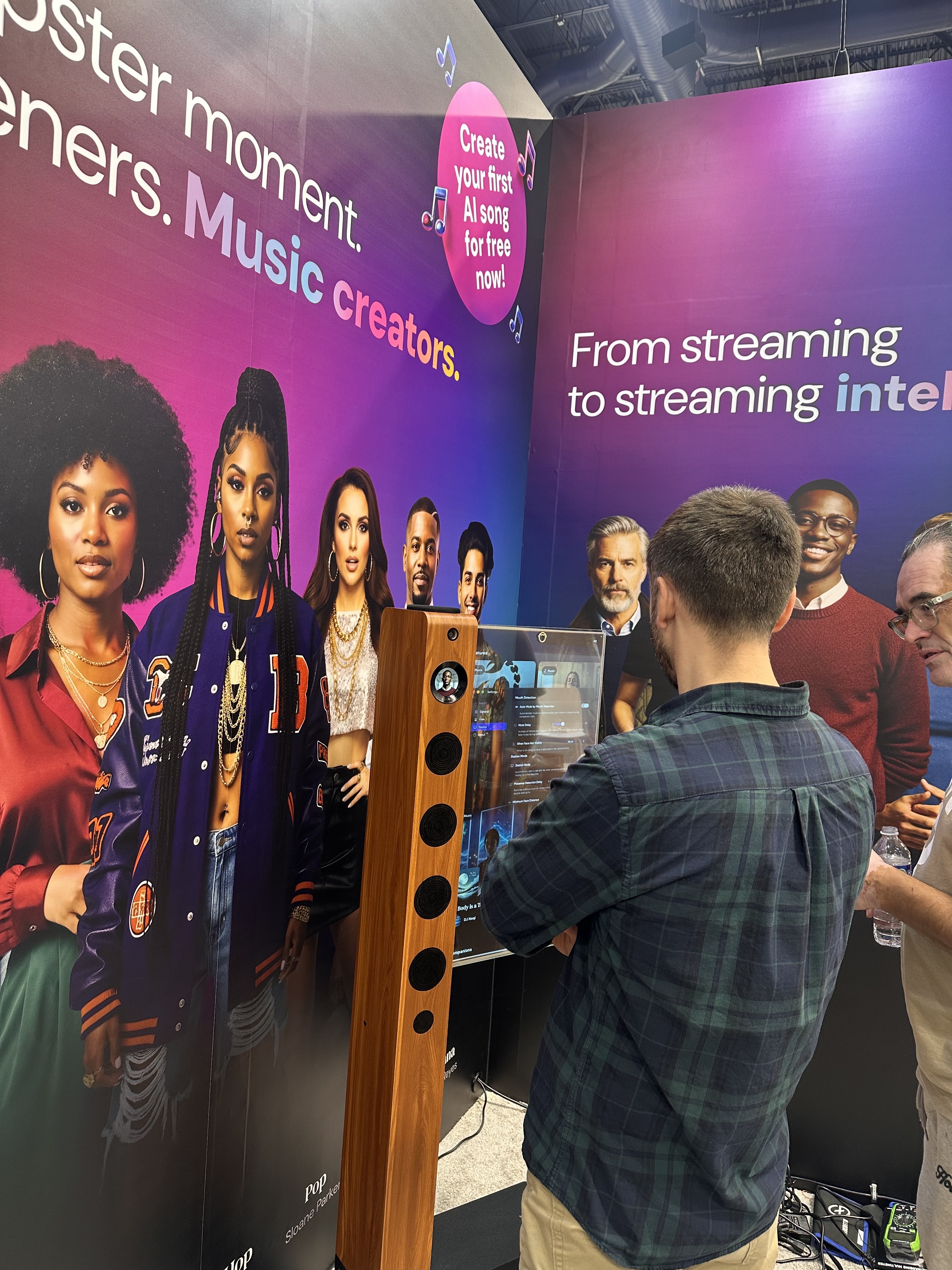
Napster was right in the middle of the moment, with the unveiling of Napster Station, an AI concierge kiosk that can augment the workforce of high-traffic businesses like hotels, convention centers, stadiums, and restaurants by enabling wayfinding, ordering, and check-in. Purpose-built to operate in high-volume environments like the CES show floor, Station gave attendees the opportunity to create their own AI music via the Napster App and have conversations in real time about what was happening on the showfloor.
The shift from text to talking, from chatbots to conversations, will redefine the use cases for AI in 2026.
Smart tech is more accessible than ever
Innovation often comes with a high price tag, but this CES showed that cutting-edge tech is becoming more accessible. Increasing competition and the fall of “walled gardens” throughout the industry has led to lower price points and democratized access to what were previously luxuries.
The widespread adoption of the Matter protocol is an example. Companies like IKEA and Aqara showcased smart sensors and lighting kits that are affordable enough for the average consumer to outfit their entire home. Meanwhile, smart glasses, home entertainment tech, laptops, phones, and even Legos have entered the frame with increasing utility and affordability.
This democratization of access has been the thesis behind Napster for decades. In 1999, it was about music. Today, Napster Companions on the Napster App democratize expertise with specialized, personality driven companions that learn about you and remember your past conversations, while helping you accomplish your goals, whether that is creating a presentation or coding your next project. Napster View extends that thesis into the physical world with a $99 dedicated device that brings your Companion to life at your desk, and it was recognized by USA TODAY and Reviewed as one of the top tech picks of CES.
Ready or not, AI is becoming omnipresent
As the industry observed throughout the week, we are witnessing the end of artificial intelligence as a simple tool. It has matured into a part of our social fabric. We are moving away from transactional interactions toward an era where technology acts as an always-on layer of our lives that coordinates, collaborates, and offers persistent perspective.
AI hardware took all kinds of forms at CES this year, and the way that digital intelligence was used changed dramatically with the shift in mediums. AI is unlike anything that’s ever been seen in tech, but like all the world’s greatest inventions, it needs to adapt to the human form factor and provide utility that people can understand and relate to their own lives. That’s why AI with a face, though at times uncanny, is such a powerful tool: It forms a connection that a text box or even a voice chat can’t replicate.
Whether it is a crew of specialists helping a creator finish a media project or an assistant that remembers your preferences across every device you own, AI is on the verge of becoming a consistent companion that makes the world a little more connected and significantly more capable.
CES 2026 was overrun with robots. But the more interesting shift wasn't about giving AI a body. It was about giving it a face.
The Las Vegas Convention Center was once again abuzz last week for the biggest tech conference of the year, and AI remained one of the hottest topics at the show. In 2024, the world obsessed over chatbots and the power of prompting. In 2025, attendees were mesmerized by agents and more specific AI utility. This year, though, was less about models and more about personalization, companionship, and the evolution of AI from a tool to a teammate.
Here are Napster’s takeaways from the show floor, keynote stages, and behind-the-scenes get-togethers that will shape tech in the year to come.
Physical AI was the talk of the show
For a long time, the industry treated AI as something trapped behind a screen. CES 2026 marked the beginning of what Nvidia CEO Jensen Huang called the "ChatGPT moment" for hardware, a statement reflected not just in the company’s self-driving car announcement but all over the show floor last week.
Attendees saw a massive amount of embodied AI – some sophisticated, others eccentric. Robots that can do your laundry worked while humans tested out a lollipop that uses bone conduction tech to let users “taste” music. There were AI fingernails and AI hair clips, AI dog collars and AI-enabled robo-pets, and ever-advancing capabilities for smart wearables, home tech, TVs, and more.
Napster was right in the middle of the moment, with the unveiling of Napster Station, an AI concierge kiosk that can augment the workforce of high-traffic businesses like hotels, convention centers, stadiums, and restaurants by enabling wayfinding, ordering, and check-in. Purpose-built to operate in high-volume environments like the CES show floor, Station gave attendees the opportunity to create their own AI music via the Napster App and have conversations in real time about what was happening on the showfloor.
The shift from text to talking, from chatbots to conversations, will redefine the use cases for AI in 2026.
Smart tech is more accessible than ever
Innovation often comes with a high price tag, but this CES showed that cutting-edge tech is becoming more accessible. Increasing competition and the fall of “walled gardens” throughout the industry has led to lower price points and democratized access to what were previously luxuries.
The widespread adoption of the Matter protocol is an example. Companies like IKEA and Aqara showcased smart sensors and lighting kits that are affordable enough for the average consumer to outfit their entire home. Meanwhile, smart glasses, home entertainment tech, laptops, phones, and even Legos have entered the frame with increasing utility and affordability.
This democratization of access has been the thesis behind Napster for decades. In 1999, it was about music. Today, Napster Companions on the Napster App democratize expertise with specialized, personality driven companions that learn about you and remember your past conversations, while helping you accomplish your goals, whether that is creating a presentation or coding your next project. Napster View extends that thesis into the physical world with a $99 dedicated device that brings your Companion to life at your desk, and it was recognized by USA TODAY and Reviewed as one of the top tech picks of CES.
Ready or not, AI is becoming omnipresent
As the industry observed throughout the week, we are witnessing the end of artificial intelligence as a simple tool. It has matured into a part of our social fabric. We are moving away from transactional interactions toward an era where technology acts as an always-on layer of our lives that coordinates, collaborates, and offers persistent perspective.
AI hardware took all kinds of forms at CES this year, and the way that digital intelligence was used changed dramatically with the shift in mediums. AI is unlike anything that’s ever been seen in tech, but like all the world’s greatest inventions, it needs to adapt to the human form factor and provide utility that people can understand and relate to their own lives. That’s why AI with a face, though at times uncanny, is such a powerful tool: It forms a connection that a text box or even a voice chat can’t replicate.
Whether it is a crew of specialists helping a creator finish a media project or an assistant that remembers your preferences across every device you own, AI is on the verge of becoming a consistent companion that makes the world a little more connected and significantly more capable.
Founded on the principle of democratizing access—first to music in 1999, now to creative expertise in 2025—Napster has consistently been at the forefront of transformational technology shifts that expand markets and empower users. The company’s latest platform turns passive consumers into active creators, providing the interface layer between foundation AI models and human creativity.
See how Enterprise can create your one-of-a-kind, immersive, 3D experience to help you drive deeper engagement, more revenue, and innovation for your brand.
From www to "wow" in under a minute. With a single click, watch as team of specialized AI agents activates to transform your website into an immersive, brand-aligned experience.
Lorem ipsum dolor sit amet, consectetur adipiscing elit. Suspendisse varius enim in eros elementum tristique. Duis cursus, mi quis viverra ornare, eros dolor interdum nulla, ut commodo diam libero vitae erat. Aenean faucibus nibh et justo cursus id rutrum lorem imperdiet. Nunc ut sem vitae risus tristique posuere.
See how iR Enterprise can create your one-of-a-kind, immersive, 3D experience to help you drive deeper engagement, more revenue, and innovation for your brand.
Lorem ipsum dolor sit amet, consectetur adipiscing elit, sed do eiusmod tempor incididunt ut labore et dolore magna aliqua. Ut enim ad minim veniam, quis nostrud exercitation ullamco laboris nisi ut aliquip ex ea commodo consequat. Duis aute irure dolor in reprehenderit in voluptate velit esse cillum dolore eu fugiat nulla pariatur.






.svg)


